
What it means
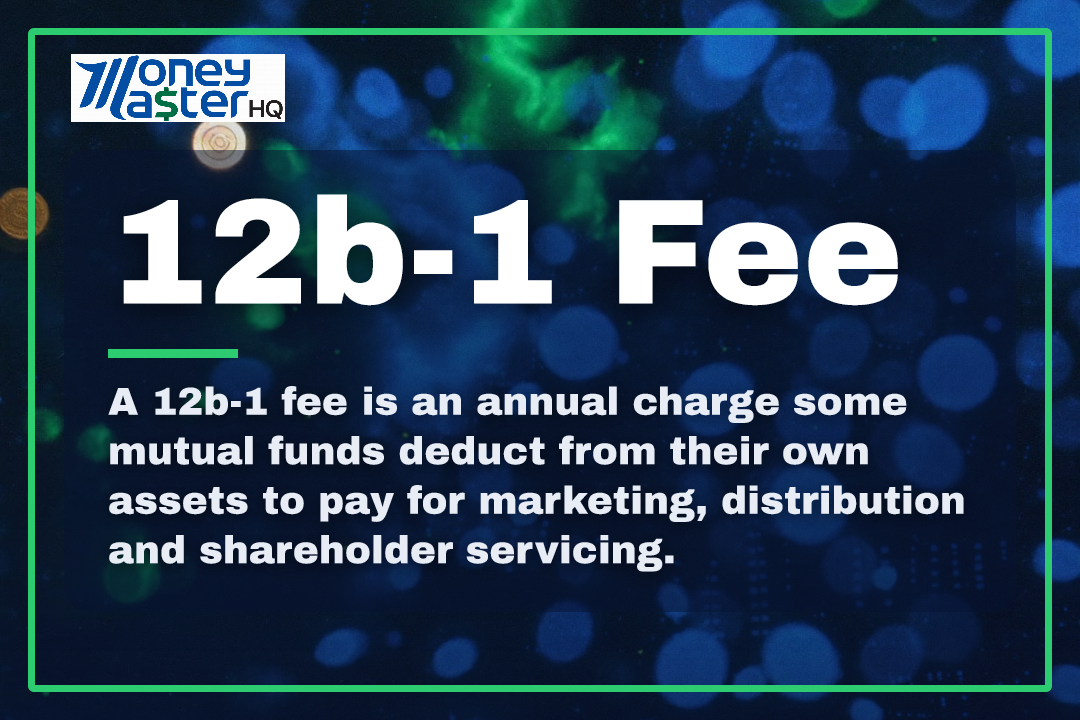
When a fund is sold through an adviser or a platform, somebody has to pay for that distribution. The 12b-1 fee lets the fund itself pay, using money that belongs to the investors already in it.
The fee is expressed as an annual percentage of assets and forms part of the fund's total expense ratio. A fund charging 0.25% takes a quarter of one per cent of your balance every year, deducted daily in small slices, which is why nothing ever shows up as a visible payment.
Two components usually sit inside the figure. A distribution and marketing portion compensates the sellers and advertisers, capped at 0.75% under industry rules, and a service portion of up to 0.25% pays for answering investor queries and maintaining accounts, giving a maximum of 1.00% in total.
The fee matters most because of how it compounds. A quarter of a per cent sounds trivial next to a year in which markets rise 12%, but over twenty or thirty years the cumulative drag can consume a meaningful slice of the final balance.
Share classes are where the fee becomes visible to those who look. The same underlying portfolio is often sold as several classes, and the class carrying a higher 12b-1 fee typically has a lower upfront sales charge, effectively trading a payment now for a bigger payment spread over time.
The direction of travel has been away from these fees. Index funds and exchange traded funds mostly carry none, and adviser fee-based accounts have been shifting towards clean share classes, though 12b-1 fees remain common in retirement plan menus and older holdings.
In practice
Real-world examples.
Example
An employee reviews her workplace retirement menu and finds two versions of the same equity fund. The institutional class carries no 12b-1 fee while the retail class carries 0.50%, so she switches and keeps roughly $340 a year on her $68,000 balance.
Example
A financial adviser explains that he receives no separate commission on a client's fund because the ongoing 0.25% service fee inside the fund pays for the relationship. The client now understands where the compensation comes from, even though no invoice is ever issued.
Example
A small charity comparing two bond funds with identical portfolios notices expense ratios of 0.55% and 0.95%. The gap is almost entirely a 12b-1 fee, and the trustees move $400,000 to the cheaper class, saving about $1,600 a year.
Think of it
“12b-1 fee is an ongoing marketing charge-paid every year from fund assets.
Formula
Calculation
Annual 12b-1 cost = account balance x 12b-1 fee rate

An investor holds $50,000 in a fund whose total expense ratio is 1.15%, of which 0.25% is the 12b-1 fee.

Annual 12b-1 cost = $50,000 x 0.0025 = $125

Compare that with a different share class of the same portfolio carrying a 1.00% 12b-1 fee.

Annual 12b-1 cost = $50,000 x 0.0100 = $500

The difference is $500 - $125 = $375 a year on the same $50,000 and the same underlying investments. Held for ten years on a broadly stable balance, that gap costs about $375 x 10 = $3,750, before counting the returns that money would itself have earned.
Case study
Seen in the real world.
Thornbury Print Works is an invented company used purely as an illustrative example. Its owners set up a retirement plan for 40 staff and chose a fund line-up recommended by the first provider they spoke to, without asking how the provider was paid.
Six years later a new office manager compared the plan's fund expense ratios with widely available alternatives. Nearly every fund carried a 0.50% 12b-1 fee that was covering both the adviser and the recordkeeping, adding roughly $14,000 a year in aggregate across a $2,800,000 plan.
Thornbury ran a competitive review and moved to share classes with no 12b-1 fee, paying the recordkeeper a flat, visible annual amount instead. Total cost fell by about $9,000 a year, and, more usefully in this fictional account, staff could finally see exactly what they were paying for and to whom.
Watch out
Common mistakes.
- Assuming a fund with no upfront sales charge is free to own. The cost may simply have been moved into an annual 12b-1 fee that continues for as long as you hold the fund.
- Comparing funds on the 12b-1 fee alone. It is only one component of the total expense ratio, and a fund with no 12b-1 fee can still be expensive overall.
- Believing the fee buys better performance. It pays for distribution and servicing, not investment skill, and higher-fee share classes hold exactly the same portfolio.
Questions
People also ask.
Where do I find the fee?
It is disclosed in the fund prospectus fee table and included within the stated total expense ratio, usually as its own line.
Is a 12b-1 fee ever reasonable?
It can be, where it replaces a separate advice charge and the total cost is competitive, but it should be a conscious choice rather than a surprise.
Do exchange traded funds charge them?
Almost never, which is one reason their expense ratios tend to be lower than comparable actively distributed mutual funds.
From the founder's library

Take it further with the book.
Build your financial confidence beyond this definition. Shihan's full-length guide, Accounting Fundamentals, takes the same plain-English approach and turns it into a complete, practical playbook for non-finance managers, business owners and students - with chapter-end quiz answers and presentation slides included.
25% off with code MMHQ25, applied at checkout. Priced in USD - checkout may show the equivalent in your local currency.
View the book and save 25%